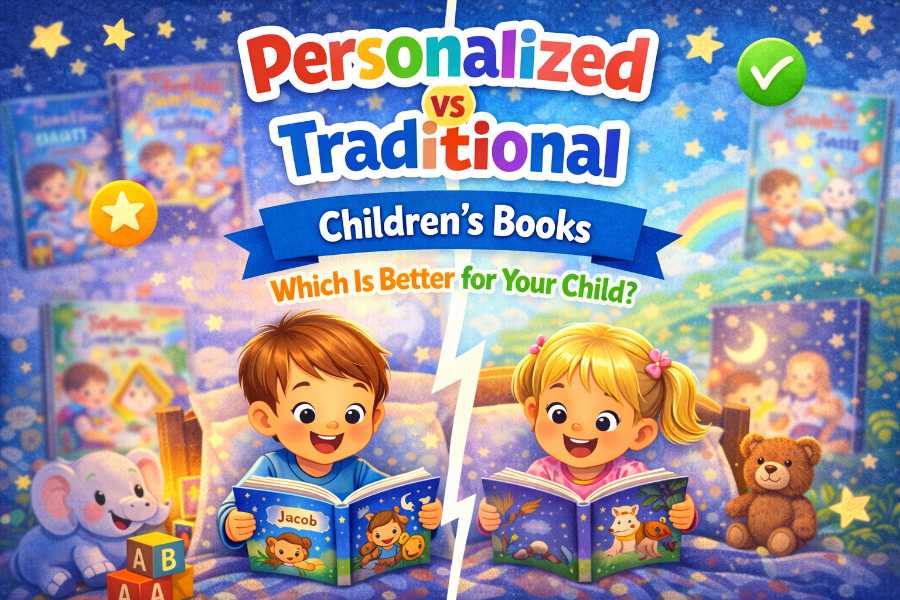
Personalized vs Traditional Children’s Books: Which Is Better for Your Child?
Parents face this choice often: a personalized book with their child’s name inside the story, or a traditional picture book many households already own. Both formats offer real benefits, and research explains why each one works.
Written with the assistance of Claude AI and reviewed by the Chilkibo Editorial Team using pediatric literacy research and child development sources
What Personalized Books Do Well
Infants start to recognize their own name around five months old, and this recognition becomes fully developed by 13 months, according to research published in Developmental Psychology. Hearing a familiar name pulls a young child’s attention away from background noise and toward the speaker. Our post on when toddlers see their name in books covers this reaction in more depth.
A 2013 study in the Journal of Early Childhood Literacy observed parents reading personalized books with children between 12 and 33 months old. The children showed significantly more smiles, laughs, and vocal sounds during the personalized book than during a similar book without personalization. Chilkibo Publishing books, designed for children 0 to 3, use this same approach, repeating the child’s printed name throughout the story.
A 2018 literature review from the National Literacy Trust, produced with personalized book publisher Librio, found that personalized books help children see themselves as readers early. If that identity holds as the child grows, the review linked it to a three year lead in reading age by age 14.
Some personalized books add short reflective questions after each page. Researcher Grover Whitehurst named this method dialogic reading in 1988. His research and the studies that followed it found open-ended questions during story time build vocabulary and language skills faster than reading straight through without pausing. Our post on questions to ask during toddler story time walks through examples parents use at home.
A related study tested preschool children on new vocabulary words placed inside a story. Children remembered the words in the personalized sections with more accuracy one and two weeks later than the words in the non-personalized sections.
What Traditional Books Do Well
Traditional picture books such as Goodnight Moon and Where the Wild Things Are introduce children to characters, settings, and emotions outside their own life. The American Academy of Pediatrics recommends reading aloud daily starting in infancy, citing gains in language, brain development, and parent-child bonding in its 2024 policy update.
Empathy in young children grows through shared reading paired with conversation, not through book type alone. A 2025 study in Frontiers in Psychology found parent-child reading of social-themed picture books raised prosocial behavior in preschoolers, with empathy accounting for most of the gain. Traditional books with well developed characters give parents natural openings for these conversations. Personalized books with reflective questions create similar openings in a different way, a point covered in how personalized books nurture emotional growth.
Quick Comparison
Name-driven attention: personalized books show a strong, research-backed effect. Traditional books have no name for a child to react to.
Vocabulary retention through repetition: personalized sections show stronger retention in the research above. Traditional books offer standard retention.
Range of characters and settings: personalized books stay narrower, built around one character. Traditional books offer a wide, established catalog built over decades.
Typical cost: personalized books cost more due to customization. Traditional books cost less since they are mass produced.
Choosing by Age
Book choice matters less before 12 months old, since name recognition is still forming. Between one and three years old, a personalized book usually holds attention longer and builds vocabulary faster, based on the research above. After age three, add traditional books with a wider range of characters and settings to build empathy and imagination alongside personalized stories.
Most Families Benefit From Both
Most families gain the most by using both book types for what each does well. Personalized books build early engagement and word learning during the toddler years. Traditional books add breadth in characters and emotional range as a child grows. Rotate between the two during story time and let your child’s reactions guide how often you reach for each one.