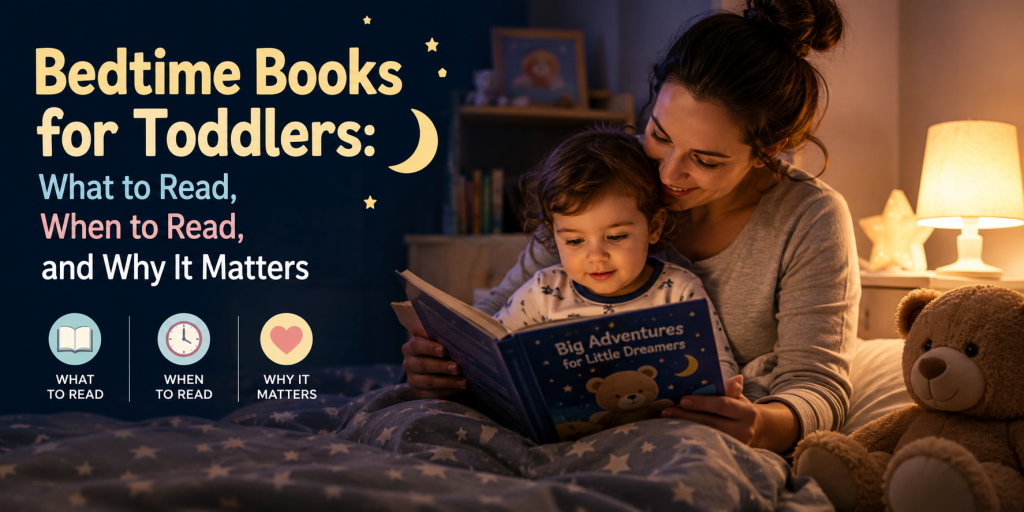
Bedtime Books for Toddlers: What to Read, When to Read, and Why It Matters
Reading to your toddler is good for them at any time of day. Reading right before bed adds a second layer of benefit that daytime reading does not. In ten minutes, you support their sleep, build their vocabulary, and strengthen your bond. Here is what the research supports, which books work best, and how to build a routine that holds up.
Written with the assistance of Claude AI and reviewed by the Chilkibo Editorial Team using pediatric literacy research and child development sources
By the Numbers
In a study of 62 Latino preschoolers, families with a consistent bedtime routine reading at bedtime saw longer total nighttime sleep in their children, compared to families without one.
A 2024 study tracking over 500 preschoolers found that time spent reading books, instead of using screens, was linked to fewer sleep problems, including easier sleep onset and less sleep anxiety.
Research presented at the 2017 Pediatric Academic Societies Meeting found that children read to starting in infancy showed stronger vocabulary and early reading skills four years later, right before starting school.
Why Bedtime Is the Best Time to Read
A consistent sequence, bath, book, sleep, signals your child’s body to start winding down. Sleep scientists call this a conditioned sleep onset association. Over time, picking up the book becomes the trigger. Your toddler’s brain starts producing melatonin earlier because it has learned what the book means.
Sleep also helps lock in new words. Researchers at the University of Sussex read preschoolers a storybook, then let some children nap and kept others awake. The children who napped afterward remembered the new words better than the children who stayed awake. The same study found children who heard the same story several times learned words better than children who heard a different story each time. Repetition and sleep both help. Reading the same book again is not something to worry about. It is doing exactly what your toddler’s brain needs.
Screens work against this. Blue light from tablets and phones suppresses melatonin production and delays sleep onset. A physical book under dim, warm lighting does the opposite. It supports the body’s move toward sleep instead of fighting it.
A Note on the Research
Most of the studies behind these findings looked at preschoolers, ages 4 to 6, rather than toddlers under 3. Solid sleep and reading research on the youngest children is thinner. The mechanisms, routine, repetition, low screen exposure before bed, hold across early childhood, so the guidance below applies the same principles down to toddlerhood. Worth knowing if you want to dig into the sources yourself.
What Makes a Good Bedtime Book for Toddlers
A high-energy story about a monster truck race works against your goal at bedtime. Look for these traits instead.
Repetition and rhythm. Toddlers process language through pattern recognition. Books with repeated phrases or a predictable structure help them follow along and feel confident. Goodnight Moon by Margaret Wise Brown and The Going-To-Bed Book by Sandra Boynton work in part because their rhythms are so consistent that toddlers pick them up within a few readings.
Calm, low-stakes plots. Bedtime books should not introduce big conflict right before sleep. Look for stories where the ending is peaceful. Animals going to sleep or characters saying goodnight to their world signal that the day is done and the world is safe.
Simple vocabulary with a few new words. A good bedtime book has mostly familiar words with two or three that need a brief explanation. That small stretch builds vocabulary over time, and sleep right after helps lock the new words in.
Short enough to finish. Most toddlers hold attention for five to ten minutes on one book. Aim for 20 to 32 pages. If your toddler wants more, read a second short book instead of choosing one long one.
Five Bedtime Books Worth Keeping on Your Shelf
Goodnight Moon by Margaret Wise Brown. A toddler says goodnight to every object in the room. The ritual mirrors what you want your child to do with the world at bedtime.
The Going-To-Bed Book by Sandra Boynton. Animals on a boat work through their bedtime routine. The pacing is slow and toddlers ask for it again and again.
Owl Babies by Martin Waddell. Three owls wait for their mother at night. The reassurance theme lands well for toddlers with separation anxiety at bedtime.
Time for Bed by Mem Fox. Animal parents put their children to sleep one by one, ending with a human child going to sleep too.
Llama Llama Red Pajama by Anna Dewdney. A llama calls for his mama after lights out. The resolution stays warm without reinforcing the habit of getting out of bed.
For more picks by age, see our guide to the best bedtime books for 2-year-olds.
Make It Personal
A book with your child’s name and face in the story builds an even stronger connection at bedtime. Personalized books hold attention longer and reinforce identity and belonging at an age when your toddler is learning who they are. You will find a full range of personalized children’s books built for toddlers and young children.
How to Build the Routine in Five Steps
Start at the same time every night. Consistent timing regulates your toddler’s internal clock. Even a 15-minute window helps.
Dim the lights before you start reading. Low light tells the brain sleep is coming. Overhead lights keep cortisol elevated and delay melatonin.
Choose one or two books together. Let your toddler pick from a small curated selection. Two or three options cut resistance without opening up a decision spiral.
Read slowly and with expression. A calm, measured voice is enough. You do not need to perform.
End the book before your toddler is fully asleep. The goal is drowsy but awake. If they fall asleep during the book most nights, the book becomes a sleep prop, and they will wake at night looking for it.
Our 15-minute bedtime routine guide breaks this down step by step if you want a printable version.
What to Do When Your Toddler Refuses to Stay in Bed
Bedtime resistance is common between ages 2 and 4. Adding books does not end it on its own, but a consistent routine reduces it. Research reviewing bedtime routines across early childhood links a predictable nightly sequence to less resistance and fewer night wakings. Predictability removes the anxiety of not knowing what happens next.
A few adjustments help further. End the routine by leaving the room before your toddler falls asleep. Keep the book selection short. When books start to feel like a delay tactic, toddlers learn to stretch them out, and two books becomes five. Set a limit at two and hold it. Choose books where the main character goes to sleep at the end. When your toddler sees the bunny, the owl, and the llama all close their eyes, their brain gets a behavioral model to copy.
Personalized Books and Why They Work at Bedtime
Standard books work well. Personalized books, where the story features your child’s name and often their likeness, work better for one reason: engagement. A toddler who hears their own name in a story pays closer attention and stays focused longer.
That attention translates into more language absorbed per reading, valuable at bedtime since you are working inside a short window. A personalized book returns more per minute of reading time and builds a positive association between books and your child’s sense of self.
Age-Specific Tips
12 to 18 months. Board books with large images and minimal text work best. Your toddler is not following the plot yet. They are learning that books mean closeness and your voice. Start now even if they seem uninterested. The connection forms before the comprehension does.
18 months to 2.5 years. Repetition matters most here. Read the same two or three books on rotation. Ask simple questions while you read: point to the moon, name the color of the blanket. Small interactions keep your toddler present and build vocabulary through context.
2.5 to 4 years. Toddlers begin to follow narrative at this age. They notice when you skip a page and correct you when you say a word wrong, a sign of real comprehension. Introduce slightly more complex language and ask prediction questions: what happens next? Their answers will surprise you.
Ten minutes, a good book, a dim lamp. Start tonight.
Sources
Ricci C, Ordnung M, Rothenbacher D, Genuneit J. “Substituting Book Reading for Screen Time Benefits Preschoolers’ Sleep Health: Results from the Ulm SPATZ Health Study.” Nature and Science of Sleep. 2024. https://pmc.ncbi.nlm.nih.gov/articles/PMC10961022/
Mindell JA, Williamson AA. “Benefits of a bedtime routine in young children: Sleep, development, and beyond.” Sleep Medicine Reviews. 2018. https://pubmed.ncbi.nlm.nih.gov/29195725/
Williams SE, Horst JS. “Goodnight book: sleep consolidation improves word learning via storybooks.” Frontiers in Psychology. 2014. https://pmc.ncbi.nlm.nih.gov/articles/PMC3941071/
Brown SJ, Rhee KE, Gahagan S. “Reading at Bedtime Associated with Longer Nighttime Sleep in Latino Preschoolers.” Clinical Pediatrics. 2015. https://escholarship.org/uc/item/3h93h92c
Cates CB, et al. “Early Reading Matters: Long-term Impacts of Shared Bookreading with Infants and Toddlers on Language and Literacy Outcomes.” Pediatric Academic Societies Meeting, 2017. https://publications.aap.org/aapnews/news/13201