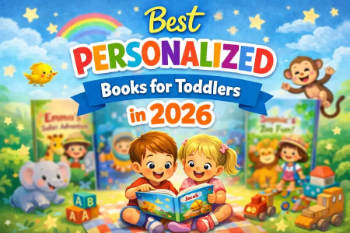
Are Personalized Books Worth It?
The short answer: yes, for most toddlers and preschoolers, with one condition. A personalized book earns its higher price when the story stands on its own merit and the personalization does real work inside the plot, not when a name gets dropped into a template with nothing else changed. Here is what the research says about why personalization helps, where it falls short, and how to tell the difference before you buy.
Written with the assistance of Claude AI and reviewed by the Chilkibo Editorial Team using pediatric literacy research and child development sources
The Engagement Difference Is Measurable
A 2013 study published in the Journal of Early Childhood Literacy observed parents and toddlers, aged 12 to 33 months, sharing three types of books: a book personalized for the child, a matched book with no personalization, and the child’s existing favorite book. Researchers coded smiles, laughs, and vocal activity during each session. Children and parents smiled and laughed significantly more often with the personalized book than with the non-personalized one, and children vocalized more with the personalized book than even with their own favorite (Kucirkova, Messer, & Whitelock, 2013).
This matters because engagement drives repetition, and repetition drives the learning outcomes covered below. A book a toddler wants to hold, point at, and request again works harder for language development than a book read once and shelved.
Personalization and Word Learning
Engagement alone does not prove a book teaches a child anything, so researchers also tested word learning directly. A 2014 experiment published in First Language read 18 preschoolers, average age three years and ten months, a picture book containing both personalized and non-personalized sections, each with unfamiliar target words woven into the text. Tested a week later, children showed significantly stronger knowledge of the words from the personalized sections than the words from the non-personalized sections (Kucirkova, Messer, & Sheehy, 2014).
The result lines up with a well established finding in memory research: children encode information tied to themselves more deeply than information tied to someone else. A 2014 study in Child Development found four to six year olds showed stronger recognition memory for objects paired with their own image than for objects paired with another child’s image (Cunningham, Brebner, Quinn, & Turk, 2014). Earlier research with preschoolers documented the same self-reference advantage in memory tasks (Ross, Anderson, & Campbell, 2011). Put together, these two research lines point to a reasonable explanation for the word-learning results above: a story built around a child’s own name and identity taps a memory advantage already present in the developing brain, rather than creating a new one from scratch.
Where Personalization Falls Short
Personalization is not automatically better. In a 2021 Scientific American piece, researcher Natalia Kucirkova, who ran several of the studies above, noted that personalized books are far from a gimmick but are also not a guaranteed upgrade. Insert a child’s name into a mediocre story with weak art, and the result is a mediocre story with a name in it (Kucirkova, 2021).
Two failure modes show up often:
- Shallow personalization. The child’s name replaces a generic name and nothing else in the plot, art, or reading experience changes. This version likely delivers a smaller share of the engagement gains found in the studies above, since those studies used books where personalization shaped the story world, not a name swap alone.
- Personalization without craft. A well made template still needs pacing, rhyme, page turns, and art that hold a toddler’s attention. Personalization adds a hook. It does not replace the storytelling fundamentals a traditional children’s book also needs.
Repetition Beats Variety, and Personalized Books Get Reread
Word learning research from the University of Sussex offers a second reason personalized books tend to perform well. Psychologist Jessica Horst found that three year olds learned new vocabulary better from one story read repeatedly than from three different stories containing the same target words across the same amount of reading time (Horst, 2013). Children do not need more books. They need the same book again.
This is where the reread appeal of personalized books compounds their advantage. Parents often report toddlers requesting their personalized book by name more than a generic title on the shelf, and every extra reread adds another rep of the contextual repetition Horst identifies as the strongest driver of word learning.
Cost Versus Value: How To Decide
Personalized keepsake books typically cost more than a standard picture book, largely from print-on-demand production and shipping rather than deeper personalization itself. That premium earns its keep under specific conditions and falls flat under others.
Personalization tends to pay off when:
- The child’s name and traits shape the plot, not only the cover or a single page.
- The illustrations show a character who resembles or represents the child.
- You expect to read the book dozens of times, since repetition is where the learning gains show up.
- The book targets a stage where self recognition is developing, roughly 18 months through age four, the same window covered in research on the best age to introduce personalized books.
Personalization is a weaker buy when:
- It is a one-time gift for an event, unlikely to get reread often.
- The story itself is thin and leans on the name insertion to carry interest.
- The child is younger than 12 months and has not developed reliable name or self recognition yet.
A Quick Checklist Before You Buy
- Read a sample page. Does the personalization change the story, or only the label?
- Check the art. Does the character resemble the child, or is it a generic figure with a name tag?
- Weigh rereadability. A gift built to be read once is a different purchase than a bedtime staple.
- Match age to content. A newborn gains little from name personalization. A two or three year old, deep in the self recognition window, gains the most.
The Verdict
Personalized books are worth the added cost when three conditions line up: the story holds up on its own, the personalization runs through the plot instead of sitting on the cover, and the child is old enough to recognize their name and see themselves in the character. Under those conditions, the research shows real gains in engagement, vocal participation, and word learning, not only a warmer feeling for parents. Skip the personalization premium for one-off gifts, thin stories, or children under a year old, where the mechanism behind the benefit has not kicked in yet.
Sources
- Kucirkova, N., Messer, D., & Whitelock, D. (2013). Parents reading with their toddlers: The role of personalization in book engagement. Journal of Early Childhood Literacy, 13(4), 445-470. https://journals.sagepub.com/doi/10.1177/1468798412438068
- Kucirkova, N., Messer, D., & Sheehy, K. (2014). Reading personalized books with preschool children enhances their word acquisition. First Language, 34(3), 227-243. https://doi.org/10.1177/0142723714534221
- Horst, J. S. (2013). Context and repetition in word learning. Frontiers in Psychology, 4, 149. https://doi.org/10.3389/fpsyg.2013.00149
- Cunningham, S. J., Brebner, J. L., Quinn, F., & Turk, D. J. (2014). The self-reference effect on memory in early childhood. Child Development, 85(2), 808-823. https://doi.org/10.1111/cdev.12144
- Ross, J., Anderson, J. R., & Campbell, R. N. (2011). I remember me: Mnemonic self-reference effects in preschool children. Monographs of the Society for Research in Child Development, 76(3). https://doi.org/10.1111/j.1540-5834.2011.00613.x
- Kucirkova, N. (2021). The Educational Power and the Limits of Personalized Children’s Books. Scientific American. https://www.scientificamerican.com/article/the-educational-power-mdash-and-the-limits-mdash-of-personalized-children-rsquo-s-books/