How Long Should Story Time Be for a 2-Year-Old?
You sit down with a book, and your two-year-old is fully in it for the first two pages. By page four, they are twisting around to look at the dog, or trying to close the book and start over, or standing up and walking away entirely. This is not a discipline problem. It matches what child development research shows about attention span at this age. Here is what a realistic story time actually looks like for a two-year-old, and how to work with it instead of against it.
Written with the assistance of Claude AI and reviewed by the Chilkibo Editorial Team using pediatric literacy research and child development sources
The Short Answer: Four To Six Minutes Of Focused Listening
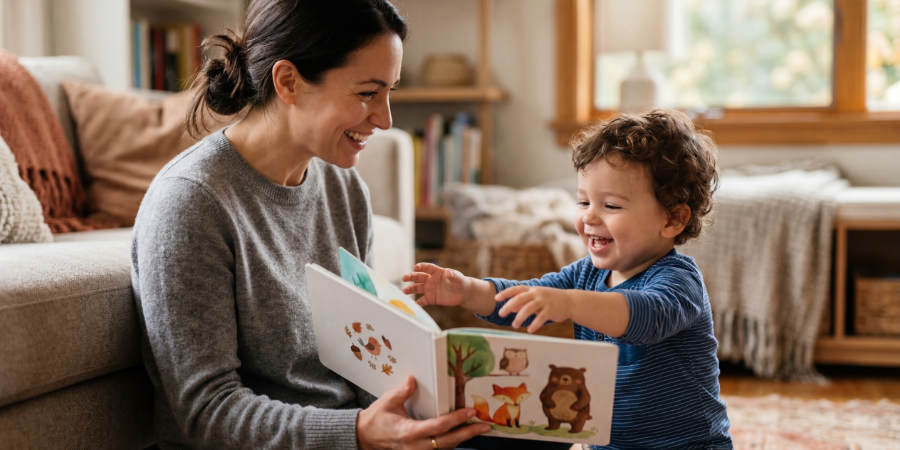
Most two-year-olds hold focused attention on an adult-led activity, including a story read aloud, for roughly four to six minutes, a range that climbs slightly to six to eight minutes once a child turns three. A separate look at toddler development puts the number similarly, noting a two and a half year old typically focuses on a specific activity for around four minutes, with sustained attention closer to fifteen minutes not expected until closer to school age. If your two-year-old checks out after one short book, that is on schedule, not behind it. LoveveryCharlotte Glaze
Why Attention Is Shorter At This Age Than You Expect
Attention span is controlled largely by the frontal lobe, and the frontal lobe is one of the last brain regions to mature, which is why focus grows steadily through toddlerhood rather than arriving all at once. A two-year-old is not choosing to tune out a story. Their brain has not built the wiring yet to sustain focus much past the five-minute mark on something they did not pick themselves. Lovevery
Focused Minutes Are Not The Same As Total Reading Time
A four-minute attention span does not mean four minutes of reading a day is enough. It means one sitting should stay short, and short sittings should happen often. Pediatric guidance recommends reading with toddlers at least once a day, with regular reading times before naps and bedtime helping a child learn to settle in with a book, rather than treating story time as one long block that has to be scheduled and defended. The American Academy of Pediatrics offers the same guidance in simpler terms, encouraging parents to read to their child daily, even if only for a few minutes at a time, since consistency matters more than length at this age. Three two-minute sessions across the day serve a two-year-old better than one ten-minute session that ends in a squirming toddler and a frustrated parent. HealthyChildren.orgToddlers Can Read
Signs Your Two-Year-Old Has Reached Their Limit
Watch the child, not the clock. Twisting away, standing up, trying to flip ahead to the last page, or reaching for a different toy all signal the same thing. They are done, and pushing past that point rarely buys you more engaged minutes. The AAP is direct about this too, advising parents they do not need to finish a story if a child loses interest, and that letting a toddler pick the book, even the same one over and over, matters more than finishing a specific title, since forcing the rest of a story a child has already checked out of tends to build frustration rather than love of reading. Toddlers Can Read
How To Stretch Those Minutes Without Forcing It
You cannot extend a two-year-old’s attention span through willpower alone, but a few habits help them use the minutes they do have.
- Choose shorter books over long ones at this age. A book that fits inside four minutes matches your child’s actual attention span instead of fighting it.
- Let your toddler pick the book, even if it means the same story again. Toddlers who choose their own book tend to sit with it longer, since picking from three or four options lets a toddler do something on their own, which builds a small sense of ownership over the activity. HealthyChildren.org
- Let your child help turn the pages. Physical participation keeps attention on the book longer than passive listening does.
- Pause and ask what they think happens next, or point at a detail in the picture. A question breaks the story into smaller, more digestible pieces.
- Read in your child’s lap when possible. Physical closeness keeps a toddler anchored to the activity, rather than drifting toward whatever else is in the room.
What This Means For Choosing Books At This Age
Short, focused reading windows favor books built for exactly this stage, ones with a handful of pages, one clear idea per spread, and a reason for your toddler to stay locked in rather than wander off after page two. A personalized book, where your child is the character on the page, tends to hold attention longer than a generic story for this reason. Our guide to toddler attention span goes deeper into how focus develops month by month, and our piece on why personalized books work better than regular story time looks at why seeing themselves in a story keeps toddlers engaged longer than a book about someone else. If bedtime is where you are trying to make story time work, our 15-minute bedtime routine guide shows how to fit a short story into a full wind-down routine without fighting your child’s actual attention span.
A four-minute story time is not a shortcut. For a two-year-old, it is the full, real thing.
Sources
Happiest Baby. Toddler Attention Span: What’s Normal and How to Improve It. https://www.happiestbaby.com/blogs/toddler/attention-span
Lovevery. How Long Should My 2-Year-Old Be Able To Focus? https://blog.lovevery.com/child-development/how-long-should-my-two-year-old-be-able-to-focus/
Nemours KidsHealth. Toddler Reading Time. https://kidshealth.org/en/parents/reading-toddler.html
HealthyChildren.org, American Academy of Pediatrics. Tips to Help Your Child Enjoy Reading Aloud. https://www.healthychildren.org/English/ages-stages/gradeschool/school/Pages/Help-Your-Child-Enjoy-Reading-Aloud-Tips-for-Parents.aspx