Travel Books for Toddlers: Comfort Items That Actually Work
Toddlers do not handle travel the way you do. New places, broken routines, and long stretches of sitting still overwhelm a small nervous system fast. Most parents pack a bag of toys and snacks to manage this. Books work better, and the research backs it up.
Written with the assistance of Claude AI and reviewed by the Chilkibo Editorial Team using pediatric literacy research and child development sources
Why Toys and Screens Fall Short
A new toy adds one more unfamiliar thing to an already unfamiliar day. Toddlers want the opposite of novelty when they are stressed. They want what they already know.
Screens carry a bigger cost than most parents realize. A 2021 study in Computers in Human Behavior tracked toddlers’ media habits and found children who used screens to manage their emotions developed more problematic media use and weaker emotion regulation over time (Coyne et al., 2021: https://doi.org/10.1016/j.chb.2021.106762). A tablet might quiet a meltdown for ten minutes. It does not teach your toddler how to calm down without one.
Snacks solve hunger, not stress. Pack them, but do not count on them for comfort.
Why Books Work
A familiar book gives your toddler your voice, your attention, and a story they already know the ending to. That predictability matters more during travel than anywhere else, because everything around your child has changed.
Personalized books add another layer. A 2013 study in the Journal of Early Childhood Literacy observed parents and toddlers reading three types of books: personalized, non-personalized, and the child’s own favorite. Children smiled and laughed more with the personalized book than with either of the other two, and talked more during the reading itself (Kucirkova, Messer & Whitelock, 2013: https://journals.sagepub.com/doi/10.1177/1468798412438068). Seeing their own name inside a familiar story gives your toddler an extra reason to stay locked in when the world around them is not.
The American Academy of Pediatrics lists familiar toys and books among its recommended tools for a calmer trip, alongside proper car seat use and realistic flight planning (HealthyChildren.org, AAP: https://www.healthychildren.org/English/safety-prevention/on-the-go/Pages/Travel-Safety-Tips.aspx). Books earn that spot honestly. They need no battery, take up no space, and never die at the worst moment.
How to Pick Travel Books
- Familiar titles. Travel is not the time to introduce something new. Pack what your toddler already loves.
- Compact, sturdy formats. Board books survive backpacks, car seat pockets, and sticky hands better than paperbacks with loose pages.
- Calm content. Save loud, chaotic stories for home. Gentle stories, or ones about travel itself, help your toddler make sense of what is happening around them.
- A personalized option. A book with your child’s name inside gives them a reason to stay engaged when the environment around them keeps shifting. If you are weighing this against another gift, personalized books tend to outlast toys (https://chilkibopublishing.com/personalized-books-vs-toys-which-gift-lasts-longer/) in a way that matters here too.
Matching Books to the Trip
Car rides: Keep two or three books within arm’s reach, not buried in luggage. Pull one out the moment restlessness starts, before it turns into a meltdown.
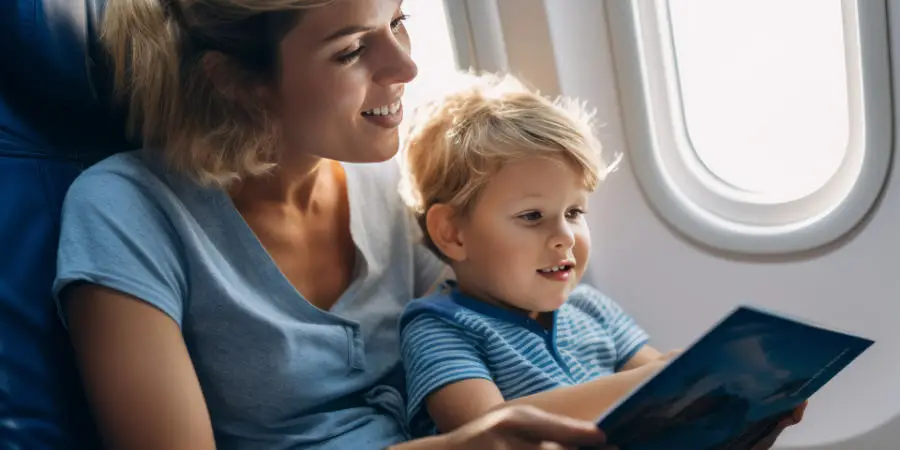
Flights: Choose light board books with no loose pieces. You do not want to search under an airplane seat for a missing flap or puzzle piece mid-flight.
Hotel stays: Bring the same bedtime book you use at home. A familiar story in an unfamiliar room does real work for helping your toddler settle into sleep.
A Simple Routine
Read the travel books at home in the days before the trip. This builds the comfort association before you need it. Once you are traveling, read at the same moments each time: getting in the car, before takeoff, before bed. Consistency does the heavy lifting, not the number of books you pack.
If you want a place to start building that travel book collection, this guide to picking personalized books for toddlers, walks through what to look for by age.
Pack fewer toys next trip. Pack the books your toddler already trusts. That is the part that travels well.
Sources
Coyne, S. M., et al. (2021). Tantrums, toddlers and technology: Temperament, media emotion regulation, and problematic media use in early childhood. Computers in Human Behavior, 120, 106762. https://doi.org/10.1016/j.chb.2021.106762
Kucirkova, N., Messer, D., & Whitelock, D. (2013). Parents reading with their toddlers: The role of personalization in book engagement. Journal of Early Childhood Literacy, 13(4), 445-470. https://journals.sagepub.com/doi/10.1177/1468798412438068
American Academy of Pediatrics, HealthyChildren.org: Tips for Safe & Stress-Free Family Travel. https://www.healthychildren.org/English/safety-prevention/on-the-go/Pages/Travel-Safety-Tips.aspx