How to Make Your Toddler Love Reading
Your toddler grabs a board book off the shelf on her own. She turns to you, book in hand, and taps your leg until you sit down. No prompt from you, no reward chart, no timer. She wants the story, not a sticker at the end.
This guide is about that second kind of reading, the kind she chooses. Frequency still matters, and a predictable daily routine is part of the answer below. But the deeper question is what turns a book from an assigned task into something your toddler reaches for on her own.
Written with the assistance of Claude AI and reviewed by the Chilkibo Editorial Team using pediatric literacy research and child development sources.
Why Loving Books Beats Reading More Often
A 2016 analysis using data from the Québec Longitudinal Study of Child Development followed French-speaking children born in Québec from birth to age 15. Children who flipped through books on their own daily at age two and a half showed higher intrinsic reading motivation in elementary school than children who did this once a week or less. Intrinsic motivation here means three things: liking books, finding them interesting, and choosing to read without being told to.
That elementary-school motivation went on to predict how well the same children did in their language of instruction at age 15. The link held after the researchers accounted for gender, the language spoken at home, socioeconomic background, and how well the children read at the start of school. The study covered French-speaking students in Québec, so treat it as strong evidence for the general pattern rather than a number that applies to every child everywhere.
You can think of this as two paths, though these are working terms rather than the researchers’ own language. One path builds a reading habit through structure and reminders. A toddler on this path reads because the routine says so. The other builds reading through curiosity and attachment. A toddler on this path reads because the story pulls her in. The first tends to fade once the reminders stop. The second tends to hold up because the child supplies her own motivation.
Build the Emotional Bond First
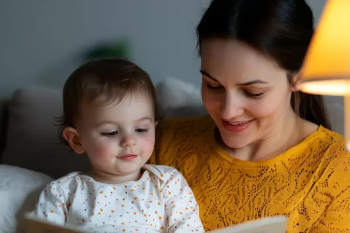
A separate line of research by developmental psychologist Adriana Bus and colleagues looked specifically at parent-child attachment and shared reading. Their studies found that children with a more secure attachment to the reading parent tended to engage more during shared reading, and that the emotional tone of a reading session, warm and unhurried versus tense or rushed, related to how much a child paid attention and took part.
None of this requires a special technique. It asks for a warm, unhurried tone.
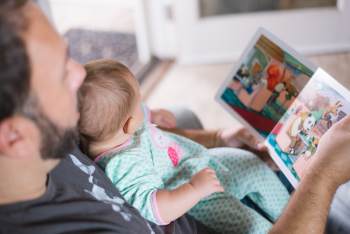
- Sit her on your lap or close beside you, not across the room
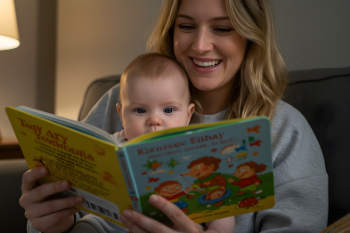
- Match your voice to the story instead of reading in a flat tone
- Follow her pointing finger and her questions before finishing the page
- Skip corrections when she mislabels a picture. Name it once, then move on
Let Your Child Lead the Story
Self-determination theory, developed by psychologists Edward Deci and Richard Ryan, identifies three needs behind intrinsic motivation: autonomy, competence, and relatedness. Applied to reading, autonomy means your toddler feels some control over how the story unfolds, beyond which book she picks off the shelf.
Give her this control inside the reading itself:
- Let her flip ahead or back without redirecting her to the correct page
- Let her ask to stop after two pages instead of finishing the book
- Let her supply the ending to a familiar line before you read it
- Save color and letter quizzes for a different moment, not mid-story
Book choice plays a role too. Keep four to six books at her height, not yours, and offer two and let her pick, rather than picking for her. A toddler who picks the next board book feels some ownership over the moment.
Turn Reading Into a Conversation
Asking questions during a book, instead of reading straight through, is called dialogic reading. A meta-analysis of 16 studies found that dialogic reading improved children’s vocabulary compared with standard read-alouds. Looking only at expressive vocabulary, across 9 studies and 322 children, the effect was moderate (Cohen’s d = 0.59). The gain shrank substantially for children aged four to five and for children at risk for language or literacy difficulties, so treat this as strongest for toddlers and young preschoolers.
The technique, developed by psychologist Grover Whitehurst, uses a small set of prompts:
- Completion: let her fill in the missing word at the end of a familiar sentence
- Recall: ask her about something from an earlier page
- Open-ended: ask what she sees or what happens next
- Distancing: connect the picture to something from her own life
A short example with a board book about a dog: read “The dog runs to the ___,” then pause and let her answer. Even a wrong answer works, then confirm the real word. Point to the dog and ask what sound it makes, then connect it to her world: “We saw a dog like this at the park.” This adds a minute or two to a five-minute book and works with anything already on your shelf.
Put Your Toddler Inside the Story
A 2013 study in the Journal of Early Childhood Literacy observed seven parents and their toddlers, aged 12 to 33 months, at home. Each pair shared a personalized book made for the child, a matched book with no personalization, and the child’s own favorite book. Children and parents showed significantly more smiles and laughs with the personalized book than with the non-personalized one. Vocal activity was significantly higher with the personalized book than with both the non-personalized book and the child’s favorite.
The sample is small, seven families, so treat this as suggestive rather than conclusive. Researchers have connected findings like this to the self-reference effect, a well-documented finding that people process information about themselves more deeply. That link is a reasonable hypothesis here. It is not something this particular study measured directly.
Not all personalization carries equal weight. A book with only your toddler’s name dropped into an unrelated template likely does less than one built around her actual details, her name, her likeness, and people and places she recognizes, though the studies above did not test that comparison directly.
What Happens in the Brain During a Story
Researchers at Cincinnati Children’s Hospital used fMRI to scan the brains of 19 children aged three to five while they listened to stories through headphones, with no pictures. Children with more reading and books at home showed stronger activity in a brain region tied to mental imagery and story comprehension, after accounting for household income. This was a small, cross-sectional study, and it shows an association rather than proof that reading causes the difference.
A follow-up study from the same group looked at reading quality rather than quantity, specifically how much a mother talked with her child during the story instead of reading straight through. That study involved 22 four-year-old girls from low-income households. Higher-quality, more interactive reading related to stronger activation in language-processing areas. Because the sample was small, all girls, and all from one income bracket, the finding is a lead worth knowing about rather than a settled result. Together, the two studies point the same direction as the behavioral research above: talking with your toddler during a story does more than reading at her in silence.
Three Signs Your Toddler Is Falling in Love With Books
These line up with the definition of intrinsic reading motivation used in the Québec research: liking the activity, finding it interesting, and engaging without being told to.
- She asks for a book at a time you did not set, during play or after breakfast, without a prompt from you
- She repeats a line from a story hours or days later, during a bath or a car ride
- She protests when the book closes and asks for one more page or one more read
A toddler showing even one of these regularly has moved past reading because you asked and into reading because she wants to.
What Gets in the Way
Two habits work against this without parents noticing.
Turning story time into a quiz undercuts intrinsic motivation. Asking her to name every color and letter on a page shifts the goal from enjoying the story to performing for approval. Save skill practice for a separate activity and keep story time about the story.
Rushing to finish the book works against her too. A toddler who senses you counting pages until bedtime picks up on the pressure, even without words for it. A shorter book read at her pace builds more of this than a longer book read at yours.
Build a Predictable Routine
The American Academy of Pediatrics recommends reading aloud daily, starting at birth and continuing at least through kindergarten. The recommendation is about consistency more than total minutes. Toddlers respond to predictable sequences: brush teeth, pajamas, choose a book, read, lights out. The routine becomes a cue that this is what happens before bed, not a lesson.
Ten minutes before bed works for most toddlers. A shorter, two-minute stretch during a diaper change or car ride adds more without asking for a longer attention span than a toddler actually has. For the research behind how much time this needs in total, see our guide to how much you should read to a toddler.
Keep Books Easier to Reach Than Screens
The AAP’s 2016 policy on media use for young children advises avoiding screens other than video chatting for children under 18 to 24 months, and limiting screen use for children two to five to about one hour a day of high-quality, co-viewed programming. In 2026, the AAP shifted its public messaging toward a broader framework that weighs content quality and context alongside time, rather than a strict hourly cap, though the general shape of the earlier guidance still holds. Check HealthyChildren.org for the most current wording before publishing.
Keep this practical, not punitive:
- Store the remote and tablet somewhere your toddler cannot reach
- Place two or three board books wherever she already sits, the car seat, the high chair tray, the living room floor
- Read one book before handing over any screen, so books become the default first step
When Your Toddler Won’t Sit Still
Match what you’re seeing to the likely cause.
| What she does | Likely cause | Try this |
|---|---|---|
| Throws or ignores the book you picked | Autonomy | Offer a choice between two books instead of one |
| Loses interest after one page | Length and format | Switch to a shorter board book with fewer words per page |
| Wants the same three books every week | Not a problem | Let her repeat until she asks for something new |
| Squirms and stands up mid-page | Physical readiness | Read while she plays nearby instead of requiring her to sit |
| Reaches for a screen instead of a book | Environment | Move books into reach and screens out of it |
A Simple Weekly Practice
Three small shifts inside the reading you already do, one to try each week.
- Pick one book to reread this week without asking her to switch it, even if you have read it ten times
- Let one reading each day run entirely on her pace, no corrections, no quizzes, no redirecting before she is ready
- Bring up a detail from the book once outside of reading time, at dinner or on a walk, and notice if she brings it up first next time
A toddler who loves books grows into a child who reads for herself, not because a parent set a timer. The habit fades without reminders. The love does not.
Sources
- Nanhou, Desrosiers, Tétreault, and Guay, Reading Motivation in Childhood and Academic Performance in the Teaching Language in High School, Québec Longitudinal Study of Child Development (2016)
- Bus and van IJzendoorn, Mother-Child Interactions, Attachment, and Emergent Literacy: A Cross-Sectional Study, Child Development (1988)
- Bus and van IJzendoorn, Mothers Reading to Their Three-Year-Olds: The Role of Mother-Child Attachment Security in Becoming Literate, Reading Research Quarterly (1995)
- Deci and Ryan, Self-Determination Theory
- Mol, Bus, de Jong, and Smeets, Added Value of Dialogic Parent-Child Book Readings: A Meta-Analysis, Early Education and Development (2008)
- Whitehurst and colleagues, Accelerating Language Development Through Picture Book Reading, Developmental Psychology (1988)
- Kucirkova, Messer, and Whitelock, Parents Reading With Their Toddlers: The Role of Personalization in Book Engagement, Journal of Early Childhood Literacy (2013)
- Hutton, Horowitz-Kraus, Mendelsohn, DeWitt, and Holland, Home Reading Environment and Brain Activation in Preschool Children Listening to Stories, Pediatrics (2015)
- Hutton, Phelan, Horowitz-Kraus, Dudley, Altaye, DeWitt, and Holland, Shared Reading Quality and Brain Activation During Story Listening in Preschool-Age Children, The Journal of Pediatrics (2017)
- American Academy of Pediatrics, Literacy Promotion: An Essential Component of Primary Care Pediatric Practice, Policy Statement, Pediatrics (2024)
- American Academy of Pediatrics, Media and Young Minds, Pediatrics (2016)