Questions to Ask During Toddler Story Time (That Actually Work)
Toddlers do not sit still for story time. One minute they point at the pictures and laugh. The next minute they climb off your lap to grab a different book. This is normal. It does not mean story time is failing.
The fix is not a better book or a quieter room, though both help. The fix is asking the right question at the right moment. A good question pulls a wandering toddler back into the page.

Written with the assistance of Claude AI and reviewed by the Chilkibo Editorial Team using pediatric literacy research and child development sources
Why Questions Matter
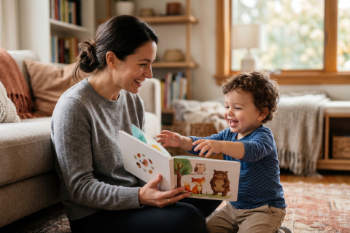
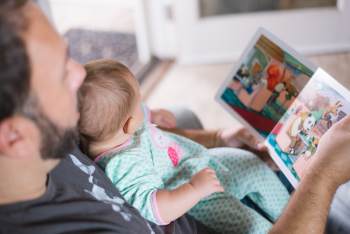
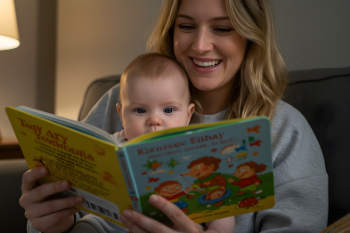
Children’s librarians and early literacy researchers call this dialogic reading. Instead of reading straight through, you pause, ask a question, and connect the story to your child’s world. Head Start’s guidance describes this directly: adults ask questions, explain new words, and tie the story to the child’s own life. This builds vocabulary and story understanding faster than reading without pausing.
A toddler who hears “What do you think happens next?” starts to practice predicting outcomes. A toddler who hears “How does the bunny feel?” starts to practice reading emotions in others. These are not just story time tricks. They are early building blocks for comprehension and empathy.
For a broader set of read-aloud fundamentals beyond questions, see How to Read Aloud to Toddlers: 8 Simple Tips for Parents.
Start with the Cover
Toddlers need a moment to shift into listening mode. Do not open straight to page one. Start with two preview questions.
“What do you see on the cover?” This gets your child looking at the book as more than an object. Follow whatever they point to, even if it has nothing to do with the story.
“What do you think this book is about?” Wrong guesses are fine. The goal is engagement, not accuracy. If your child guesses a book about a lost puppy is about a dinosaur, go with it. Say “Let’s read and find out.”
Questions to Use While You Read
Keep these short. They work best as quick check-ins, not a quiz.
Observation. “What’s happening in this picture?” or “Can you find the red ball?” These questions turn a wandering toddler back to the page and work like a gentle game of I Spy.
Prediction. “What do you think happens next?” works best right before you turn a page. Pause first. Give your child a few seconds before you answer for them.
Connection. “Have you felt like that before?” When a character is happy, scared, or frustrated, tie it to something your child has felt. This makes the story land closer to home.
Action. “Can you show me how the elephant walks?” or “What sound does the train make?” Toddlers stay engaged longer when their bodies get involved, not just their ears.
One age note matters here. Jbrary, a resource built by two working children’s librarians, points out that toddlers learn to answer yes-or-no questions and two-choice questions first. Open-ended prediction questions like “What do you think happens next?” land better once a child is closer to age two and a half or three. With a younger toddler, try “Is the dog happy or sad?” instead of “How does the dog feel?” You will get more real answers and less silence.
Follow up on What They Say
This is the step most parents skip. Your toddler answers a question, you say “good job,” and you move to the next page. Try one more beat instead.
If your child says the bunny looks sad, ask “Why do you think the bunny is sad?” If they predict the character will run away, ask “Where do you think they’ll go?” This second question tells your child their answer mattered, and it stretches the conversation further than a single exchange does.
Questions That Fall Flat
Some questions feel like a test, not a conversation. Toddlers notice the difference and disengage.
- “What color is the dog?” Skip this unless color is part of the story or your child is actively learning colors right now.
- “What letter does ‘ball’ start with?” Save letter questions for later. Most toddlers are not ready for this, and it turns story time into schoolwork.
- “What happened on the last page?” This tests memory under pressure. Focus on the current page instead.
Timing Matters More Than the Question iItself
Do not ask a question on every page. That breaks the rhythm and frustrates both of you. Good moments to pause include right before a page turn, when a character’s face changes, or when the picture shows something unexpected. If your toddler is locked in and listening, let the story run. You can always circle back with questions after you finish the book.
Make it Sound Like Curiosity, Not a Quiz
Your tone carries more weight than your wording. Try “Wow, look at all this on the page!” instead of “What do you see?” Try “I wonder why the bear has a hat” instead of “Why does the bear have a hat?” Give your child a few seconds of silence before jumping in. Counting to five in your head works well here.
What to Ask at Each Age
12 to 18 months. Stick to simple observation and pointing. “Look, a doggy!” or “Where’s the ball?” Keep it short.
18 to 24 months. Two-choice questions work best now. “Is the cat big or small?” A few simple action requests fit too, like “Can you hop like the bunny?”
Two years old. Open-ended prediction questions start to land, along with basic emotion questions like “How does the bunny feel?” Full understanding of another person’s perspective, what psychologists call theory of mind, does not fully develop until closer to age four or five. At two, your child is only beginning to notice that other people, or characters, feel things differently than they do. Keep emotion questions simple and concrete at this stage.
When Questions Aren’t Landing
Silence. Your child may need more time to process, or the question may be too advanced for their stage. Drop back to simple observation questions.
Random answers. This is normal. Toddlers often answer based on what’s in their head, not what you asked. Acknowledge the answer and move on.
Fast page-flipping. Your child may be in a browsing mood, not a listening mood. Follow their lead and try again another time. If this happens often, it may be worth a look at Toddler Attention Span: How Personalized Stories Keep Kids Engaged, which covers what typical attention spans look like at this age and what actually holds a toddler’s focus.
The Long View
You do not need a full set of questions at every reading. Some days, reading straight through is the right call. Even one or two questions per session builds the habit of interactive reading over time, and that habit is linked to stronger comprehension and vocabulary later on.
Sources
- Head Start, “Read It Again! Benefits of Reading to Young Children”
- Lindsey Krabbenhoft, Jbrary, “Pacing a Toddler Storytime”
- Simply Psychology, “What Is Theory of Mind in Psychology?”