When Should You Start Reading to Your Baby?
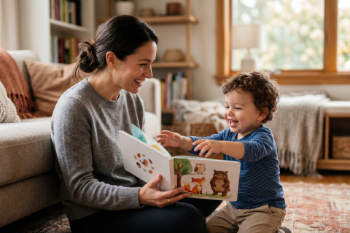
You can start reading to your baby on day one. The American Academy of Pediatrics (AAP) recommends shared reading beginning at birth. You do not need to wait until your baby sits up, babbles, or points at pictures.
Written with AI assistance and reviewed by the Chilkibo Editorial Team using pediatric literacy research and child development sources.
This guide answers four common questions from parents of young babies. It uses AAP, CDC, and pediatric health sources. It is general information and does not replace advice from your baby’s pediatrician.
How Early Should I Read to a Baby?
Start at birth. The AAP recommends shared reading from birth through at least kindergarten, including in the neonatal intensive care unit when possible. The AAP first asked pediatricians to promote reading aloud from birth in 2014. Its 2024 policy statement repeats that advice.
Your newborn will not follow the plot. They hear your voice and feel you close. The AAP says regular reading with young children supports healthy brain development and strengthens the bond between parent and child. Those gains build language, literacy, and social-emotional skills. That is the real work of reading at this age.
Short sessions add up over time. For example, reading for 30 minutes a day over five years adds up to about 913 hours. Even 10 minutes a day totals roughly 304 hours over the same period. These figures illustrate how small daily habits accumulate; they do not mean that a particular number of reading hours guarantees a specific developmental outcome. Start with a few minutes when your baby is young and build a routine that works for your family.
Pediatric clinics support early reading, too. Reach Out and Read encourages families to share books from infancy through early childhood. Ask your pediatrician whether a local program provides free books or reading guidance. When choosing a first book, look for sturdy pages, clear illustrations, and simple language. For example, Chilkibo’s personalized books for ages 0 to 3 offer short stories and animal illustrations that parents can use to start conversations with their babies.
Is It Good to Read to a 2-month-old?
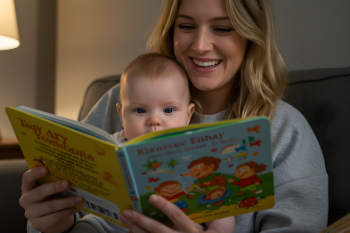
Yes. Reading to a 2-month-old is a simple way to build closeness and introduce your baby to the sounds of language. At this age, your baby may look at your face, watch you as you move, and smile when you talk or smile at them. The CDC lists these among the social and communication milestones many babies reach by 2 months.
Choose a quiet moment when your baby is awake and comfortable. Hold your baby securely and position the book where you can both see it. Point to a picture and name what you see: “Look at the little dog” or “Here is a red ball.” Your baby does not need to understand the words. Hearing your voice and sharing your attention are enough to make the experience worthwhile.
Keep reading sessions short. A few minutes may be plenty, especially when your baby is tired or hungry. You can repeat a favorite book, describe a single picture, or simply talk about the images. There is no need to finish every page. If your baby looks away, becomes fussy, or seems tired, take a break and try again later.
Every baby develops at their own pace. If you have concerns about your baby’s vision, hearing, or development, discuss them with your pediatrician. The CDC’s 2-month milestone checklist can help you understand what to look for and when to seek guidance.
Can I Read to My 3-month-old?
Absolutely. By around 3 months, reading can become more interactive, even though your baby cannot yet understand a story. Instead of simply reading aloud, give your baby time to respond. Read a short sentence, pause, and watch for a movement, a change in expression, or a sound. If your baby coos or gurgles, answer with a few words before continuing.
This back-and-forth interaction is an early form of conversation. You might say, “There’s a big elephant!” and then pause to see how your baby reacts. Try changing your tone of voice, making a gentle animal sound, or pointing to a picture. Follow your baby’s interest rather than trying to read every word on the page.
Choose books with large, clear pictures and simple images. You can describe what you see instead of following the text exactly. If your baby seems fascinated by one picture, stay there for a while. If they lose interest, change activities or finish for the moment. Reading should feel like a shared experience, not a task your baby has to complete.
Development varies from baby to baby. The CDC’s milestones are organized around ages such as 2 and 4 months, rather than providing a separate checklist for every month. By 4 months, many babies make sounds back when someone talks to them and turn their heads toward the sound of a voice. These milestones offer a general guide, not a deadline every baby must meet. If your baby does not seem to respond to sounds or you have concerns about development, contact your pediatrician rather than waiting for the next scheduled visit.
When Should You Start Reading to Your Baby at Bedtime?
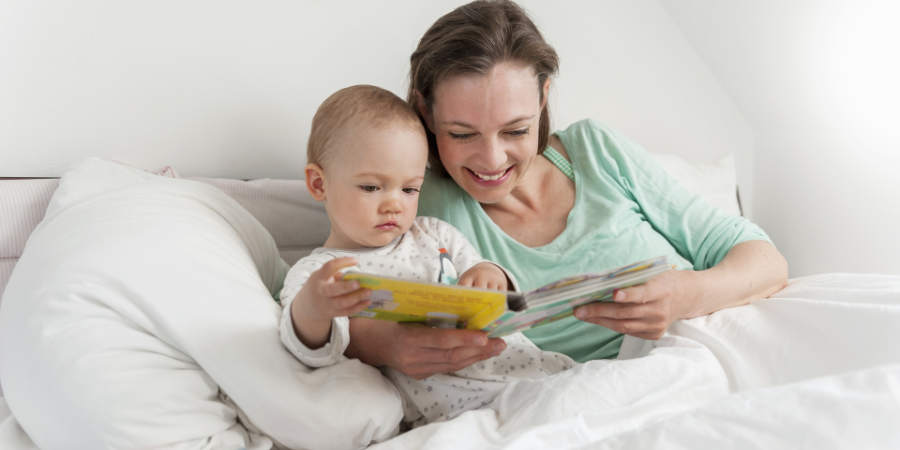
You can introduce a short bedtime story from the newborn stage. The American Academy of Pediatrics (AAP) recommends reading aloud beginning at birth, and a book can become a familiar part of your evening routine. The AAP’s Brush, Book, Bed program promotes a predictable nighttime ritual: brush your child’s teeth, read a favorite book, and go to bed at a regular time. You can start sharing books well before your baby’s first tooth appears; toothbrushing becomes part of the routine when teeth emerge.
Keep the routine simple and flexible. You might feed your baby, change their diaper, read a short book, and then prepare them for sleep. Repeating a familiar sequence can help make evenings more predictable. Young babies may not follow a fixed bedtime every night, so focus on a calm, consistent routine rather than a strict schedule. Reading can be a comforting part of that routine, although it does not guarantee that your baby will fall asleep more easily.
Keep safe sleep separate from story time. The AAP recommends placing babies on their backs for every sleep, on a firm, flat, non-inclined sleep surface in a crib, bassinet, or approved play yard. Keep pillows, loose blankets, stuffed toys, and other soft objects out of the sleep space. Room-sharing, with your baby’s separate sleep surface in your room, is recommended for at least the first 6 months.
If your baby falls asleep during story time, place them on their back in their own crib, bassinet, or other approved infant sleep space. Always use a firm, flat, non-inclined surface with only a fitted sheet. Do not leave pillows, loose blankets, stuffed toys, or other soft objects in the sleep space. Never fall asleep with your baby on a sofa or armchair. For the latest recommendations, consult the AAP’s parent guide to safe sleep.
Choose a short book with clear pictures, simple language, and a calm tone. Repeating the same book is fine; babies do not need a new story every night. Follow your baby’s cues, keep the experience relaxed, and stop if they become unsettled. The goal is to share a quiet moment together, not to make bedtime another task to complete.
Sources
- American Academy of Pediatrics (AAP), Literacy Promotion: An Essential Component of Primary Care Pediatric Practice (2024).
- The New York Times, Pediatrics Group to Recommend Reading Aloud to Children From Birth (2014).
- Michigan State University Extension, New Prescription for Parents: Read to Your Babies.
- Children’s Hospital of Philadelphia, Reach Out and Read.
- HealthyChildren.org (AAP), Brush, Book, Bed: How to Structure Your Child’s Nighttime Routine.
- HealthyChildren.org (AAP), Developmental Milestones: 1 to 4 Months.
- CDC, 2-Month Online Milestone Checklist.
- CDC, 4-Month Online Milestone Checklist.
- CDC, Milestone Checklists by Age.
- Mayo Clinic, Infant Development: Birth to 3 Months.
- Michigan Medicine, 2-Month-Old Developmental Milestones.
- Johns Hopkins Medicine, Healthy Sleep Habits.
- ZERO TO THREE, Newborn Sleep: Safe Sleep Suggestions.
- HealthyChildren.org (AAP), How to Keep Your Sleeping Baby Safe: AAP Policy Explained.