
Physical Books vs Tablets: What Toddlers Actually Prefer
Your toddler reaches for your phone instead of the board book you picked out for story time. Or the opposite happens. You download a well reviewed reading app, and your toddler still carries the same worn board book around the house. Both patterns show up in homes everywhere. Neither one means something is wrong with your child or your parenting.
This guide looks at what the research says about toddlers, physical books, and tablets. It covers current data on device use, what the American Academy of Pediatrics recommends by age, and how to build a reading routine your family will stick with.
Written with the assistance of Claude AI and reviewed by the Chilkibo Editorial Team using pediatric literacy research and child development sources
What the Research Shows
Tablets reach toddlers earlier than most parents expect. Common Sense Media’s 2025 census on media use by kids age zero to eight found that 40 percent of children own a tablet by age 2. This share climbs to 58 percent by age 4. Children under 2 average about an hour of screen time a day. Kids age 2 to 4 average a little over two hours.
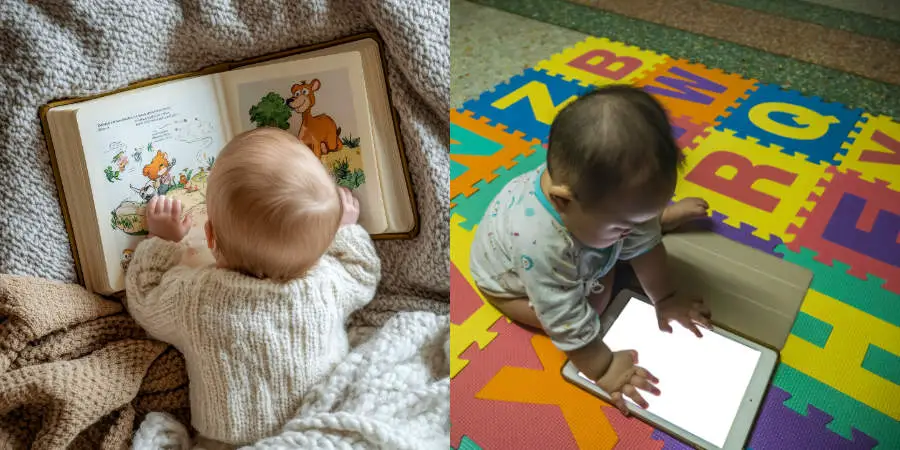
Owning a tablet is not the same as preferring one for story time. A 2019 review in the journal Child Development Perspectives, by researcher Natalia Kucirkova, pulled together findings across dozens of studies comparing print and digital books. The results were mixed, not one sided. In some studies, toddlers picked up new words faster with digital books built around synced narration and illustrations. In others, kids showed weaker story comprehension with heavily animated digital books compared to print versions of the same story. Format alone did not decide the outcome. Two things did: how the digital book was designed, and whether a parent read alongside the child.
This second point carries the most weight. A 2019 study in the journal Pediatrics, led by Tiffany Munzer at the University of Michigan, observed parent-toddler pairs reading print books and tablet apps together. Parents talked more, asked more questions, and had richer back and forth exchanges during print reading. Children who tended toward big emotional reactions responded better to their parents during print sessions too. The tablet did not only compete for the child’s attention. It changed how the parent read.
Why Physical Books Tend to Work Well for Toddlers
Toddlers learn through touch as much as sight. Paper has texture and weight. Turning a page takes a small, deliberate motion a toddler practices and repeats. This kind of hands-on interaction helps young children build an early sense of cause and effect and sequence, ideas they are still working out at this age.
Physical books also hand control to the child. A toddler flips back to a favorite page, lingers on a picture, or skips ahead on their own. Tablets often get in the way of this instinct. A stray tap skips a page or triggers a sound effect the child did not choose, which tends to frustrate rather than delight.
Fewer distractions come built in too. A physical book does not light up, buzz, or offer a tempting icon in the corner of the screen. This focus supports the kind of sustained, back and forth reading time researchers link to stronger language development.
When Tablets Add Value
Tablets are not automatically bad for early reading. A few situations bring out their strengths.
Well designed interactive books, where sounds and animations tie directly to the story instead of sitting on top of it, sometimes outperform print. Kucirkova’s review cites a Canadian study of toddlers age 17 to 26 months who picked up more new words from digital books than from print versions of the same stories, when the interactive features supported the narrative instead of distracting from it.
Children with certain developmental needs benefit too. Adjustable text size and contrast help kids with visual impairments. Touchscreens are sometimes easier to manage than page turning for kids working on fine motor skills.
Tablets also solve real logistics problems. On a flight, in a waiting room, or on a long drive, a tablet loaded with a few good books beats carrying a stack of hardcovers.
A Note on Attention Span
Occupational therapists and early childhood specialists often use a rough guideline: about 2 to 3 minutes of sustained attention for every year of a child’s age. Under this estimate, a 2 year old might hold focus on a preferred activity for 4 to 6 minutes. Treat this as a working estimate rather than a fixed rule. Hunger, fatigue, and how much a child likes a specific book change the number a lot. For more on what this looks like in practice, see our guide to toddler attention span and how personalized stories keep kids engaged (https://chilkibopublishing.com/toddler-attention-span/).
What the AAP Recommends by Age
The American Academy of Pediatrics and the CDC set clear screen time guidance for young children.
Guidance breaks down by age. If your child is under 18 months, avoid screen time outside of video calls with family. Between 18 and 24 months, limit screens to high quality programming you watch together. From 2 to 5 years, cap screen time at one hour a day of high quality programming, and co-view when you can.
In 2026, the AAP moved away from a strict hourly cap toward five questions built into a 5 Cs framework: whether the content fits your child, whether the content itself is good, whether it helps your child stay calm rather than escalate, whether it crowds out sleep, play, or family time, and whether it supports real communication. The one hour a day figure for ages 2 to 5 still works as a practical benchmark, but the newer guidance puts more weight on context than on the clock.
Given these limits, physical books make up most of a toddler’s reading time by default. Even a child who enjoys tablet stories will spend far more hours with print, simply because screen time stays capped and reading does not.
Why Your Own Habits Matter
Toddlers pick up on what the adults around them value. The Munzer study found richer conversation during print reading. Some of this difference likely comes from parents themselves engaging more when a screen is not competing for their attention too. A toddler who watches you read a physical book, and gets asked questions about the pictures, tends to treat physical books as the more rewarding choice. The habit builds on itself.
Building a Routine That Works
Most families do best with a rough split rather than an all or nothing rule. Save physical books for the bulk of your reading time, especially at bedtime and for close one on one reading. Save tablets for travel, waiting rooms, or specific high quality apps you have previewed yourself.
Bedtime deserves physical books in particular. Screens before sleep interfere with the body’s wind down process, and a predictable physical routine helps a toddler settle. Our guide to a 15 minute bedtime routine with personalized books walks through one way to structure this (https://chilkibopublishing.com/15-minute-bedtime-routine-personalized-books-that-help-kids-sleep/).
Reading aloud strengthens your toddler’s language skills more than the format of the book does. If you want practical technique tips, our guide on how to read aloud to toddlers covers pacing, voices, and how to handle a toddler who will not sit still (https://chilkibopublishing.com/how-to-read-aloud-better/).
Signs Digital Reading Might Need a Reset
A few patterns are worth watching. A toddler who suddenly cannot settle into a physical book they used to enjoy might be overstimulated by faster paced digital content. A child who wants to watch a story passively rather than touch and explore it might benefit from more hands-on print time. Meltdowns specifically over losing tablet access, more intense than typical toddler frustration, are worth mentioning to your pediatrician.
The Bottom Line
Format matters less than most parents assume. What helps a toddler’s language and comprehension most is an adult sitting close, asking questions, and pointing at the pictures, whether the pages are paper or glass. Physical books make this kind of engagement easier by default and carry fewer built-in distractions. Tablets earn their place for travel, specific well designed apps, and accessibility needs. Pick physical books for the bulk of your reading time, and reach for a tablet when it solves a real problem instead of out of habit.
Sources
- Common Sense Media. The Common Sense Census: Media Use by Kids Zero to Eight, 2025. — https://www.commonsensemedia.org/research/the-2025-common-sense-census-media-use-by-kids-zero-to-eight
- Kucirkova, N. Children’s Reading With Digital Books: Past Moving Quickly to the Future. Child Development Perspectives, 2019. — https://academic.oup.com/cdpers/article/13/4/208/8231498
- Munzer, T.G., Miller, A.L., Weeks, H.M., Kaciroti, N., Radesky, J. Differences in Parent-Toddler Interactions With Electronic Versus Print Books. Pediatrics, 2019. — https://publications.aap.org/pediatrics/article/143/4/e20182012/76785/Differences-in-Parent-Toddler-Interactions-With
- NAEYC and the Fred Rogers Center. Technology and Interactive Media as Tools in Early Childhood Programs Serving Children From Birth Through Age 8, 2012. — https://www.naeyc.org/files/naeyc/file/positions/ps_technology_web2.pdf
- Munzer, T., Parga-Belinkie, J., Milkovich, L.M., et al. Digital Ecosystems, Children, and Adolescents: Policy Statement. American Academy of Pediatrics, Pediatrics, 2026. — https://publications.aap.org/pediatrics/article/157/2/e2025075320/206129/Digital-Ecosystems-Children-and-Adolescents-Policy