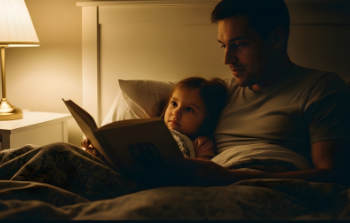
Why Reading Before Bed Helps Toddlers Wind Down
Bedtime with a toddler often looks like negotiation. One more song, one more sip of water, one more trip out of bed. A short story changes the shape of the evening. Reading before bed toddler routines rank among the most researched tools for calming an overstimulated child, and the science behind them goes well beyond comfort. A reading before bedtime toddler habit works because it gives a busy brain somewhere to land before the lights go out.
Written with the assistance of Claude AI and reviewed by the Chilkibo Editorial Team using pediatric literacy research and child development sources

The Science Behind Reading Before Bedtime For Toddlers
A toddler’s brain runs on stimulation all day: running, exploring, testing limits, and absorbing new words. By evening, the nervous system needs a clear signal to shift gears. Sleep researchers at Saint Joseph’s University tested this directly. Their randomized study of 405 mothers and their infants and toddlers, published in the journal Sleep, showed families who followed a consistent nightly routine, including a story, fell asleep faster, woke less at night, and slept longer overall. Mothers in the study also reported improved mood, since a calmer bedtime lowers stress for the whole household.
A newer analysis, published in Frontiers in Sleep, backs this up. Consistent bedtime routines, followed five or more nights per week, link to an earlier bedtime, shorter time to fall asleep, fewer night wakings, and longer total sleep, along with gains in early social and emotional development. Reading fits naturally into this sequence. It needs no equipment, works in almost any setting, and pairs a familiar voice with a steady rhythm, two things a toddler’s nervous system responds to at the end of the day.
How A Bedtime Story Calms An Overstimulated Brain
Toddlers thrive on predictability. When the same steps happen in the same order each night, the brain starts to anticipate what comes next, and anticipation lowers alertness. A story adds three things a toddler’s nervous system needs before sleep: physical closeness, a slower pace, and a fixed stopping point.
Closeness matters first. Sitting or lying near a parent while listening to a story shifts a toddler out of the alert, exploratory mode of the day into a quieter state. Pace matters too. Speech during reading tends to move slower than daytime chatter, and a toddler’s breathing often settles to match it. A fixed stopping point, the last page, gives a toddler a clear marker for how much time is left before lights out, which cuts down on stalling and pleading for “one more thing.” Keeping the book short also respects a toddler’s attention span, which shifts by age and tends to be shorter in the evening than earlier in the day.
Benefits Of Reading Before Bed, Backed By Research
The advantages of a bedtime story go beyond falling asleep faster.
- Toddlers with a consistent reading routine fall asleep sooner and wake less overnight, according to the Mindell study cited above.
- A language rich bedtime routine, including book sharing or storytelling, links to stronger language ability, cognitive skills, and later academic achievement.
- Bedtime books lower resistance to sleep. A story signals the wind down has started, which reduces stalling and tears at lights out.
- The routine benefits parents too. Mothers in the original bedtime routine trial reported better mood once bedtime conflict eased.
For families building a full evening routine, the 15 minute bedtime routine with personalized books walks through a step by step order pairing well with these findings.
Why Books Work Better Than Screens Before Sleep
The hour before bed is not neutral. Backlit screens emit blue light, a wavelength known to suppress melatonin, the hormone signaling the brain it is time to sleep. Pediatric guidance recommends avoiding screens for at least one hour before bedtime, since blue light from tablets and phones affects melatonin more than other wavelengths and tricks the brain into feeling alert when it should feel sleepy.
Young children feel this effect more than adults. Their eyes are more sensitive to light, likely because of larger pupils and clearer lenses, and researchers found even dim light exposure in the hour before bed sharply reduced melatonin levels in preschoolers. A printed book carries none of this risk. Page turns, warm lamp light, and a parent’s voice give a toddler the same wind down ritual without disrupting melatonin production.
Personalized books work well in this slot too. A story starring your child’s own name gives a toddler another reason to stay engaged with a physical page instead of asking for a tablet at bedtime.
What Makes A Good Bedtime Story For Toddlers
Not every book fits the final slot before lights out. Strong bedtime stories for toddlers tend to share a few traits.
- Short length. Toddlers rarely sit through a long narrative at the end of the day, when attention is already lower than earlier in the day.
- A calm plot. Save chase scenes, monsters, and loud endings for daytime. Bedtime books work best with gentle pacing and a quiet close.
- Familiar characters or a familiar structure. Predictability lowers effort for a tired brain, and a toddler often settles faster with a pattern they already know.
- Repetition. If your toddler asks for the same book five nights straight, let them. Repeated readings build vocabulary while reinforcing the wind down signal. The piece on why toddlers love reading the same book again and again covers the reasoning in more depth.
Letting your toddler pick the book adds one more advantage: engagement. A child who chooses the story tends to listen more closely and settle faster than one handed a random title. The guide on how to let your toddler choose books covers this in practice.
Building A Toddler Bedtime Reading Routine
A workable routine does not need to be complicated. Pediatric sleep guidance points to consistency over complexity.
- Keep the order the same each night. Bath, pajamas, teeth, book, lights out, in whichever sequence fits your household, works best when it repeats without change.
- Turn off screens at least one hour before the first step. This gives melatonin time to recover before the story even starts.
- Read in the same spot each night, ideally somewhere dim and quiet, away from toys and activity.
- Choose one or two short books instead of an open ended stack, so bedtime does not turn into a negotiation over “one more.”
- Keep your voice low and steady as the story goes on. Match the pace to your toddler’s breathing, not the other way around.
For a full breakdown of how many books fit into a single sitting, the article on how many books to read to a toddler each day offers age specific guidance. If bedtime keeps sliding later than planned, bedtime books for toddlers: what to read, when to read, and why it matters covers timing in more detail. Toddler specific title picks are also covered in best bedtime books for 2 year olds.
Making Reading Part Of Your Toddler’s Wind Down
A single bedtime story will not fix every sleep struggle overnight. Toddlers still stall, still ask for water, still climb out of bed some nights. What changes over weeks is the pattern. A predictable story, read in the same spot, at the same point in the routine, gives a toddler’s brain a reliable cue: the day is ending. Paired with a screen free hour and a short, calm book, reading before bed remains one of the simplest, best supported habits parents build into a toddler’s evening.
Sources
- Mindell, Telofski, Wiegand, and Kurtz. A Nightly Bedtime Routine: Impact on Sleep in Young Children and Maternal Mood. Sleep, 2009.
- Bedtime routines, development, and caregiver educational attainment in toddlerhood. Frontiers in Sleep.
- American Academy of Pediatrics, via HealthyChildren.org. Melatonin for Kids: What Parents Should Know About This Sleep Aid.
- Sleep.com. How Screen Time Is Impacting Your Toddler’s Sleep.
- American Academy of Pediatrics. Literacy Promotion: An Essential Component of Primary Care Pediatric Practice, Policy Statement.
- Sleep Foundation. Perfecting Your Child’s Bedtime Routine.